Most people who come in about a sensitive tooth have been living with it for months. It usually starts small. Cold water, a sharp little jolt, gone before you’ve finished the sip. You notice it, you don’t think much of it, and somewhere along the way you start chewing on the other side. Not as a decision. You just stop using that tooth.
That’s the part worth knowing about. Sensitivity is easy to work around, so people work around it, and by the time they mention it at a cleaning they can’t say when it started. Some of what causes it clears up on its own. Some of it doesn’t, and keeps going while you avoid ice in your drinks.
What Is Actually Happening When Cold Hurts
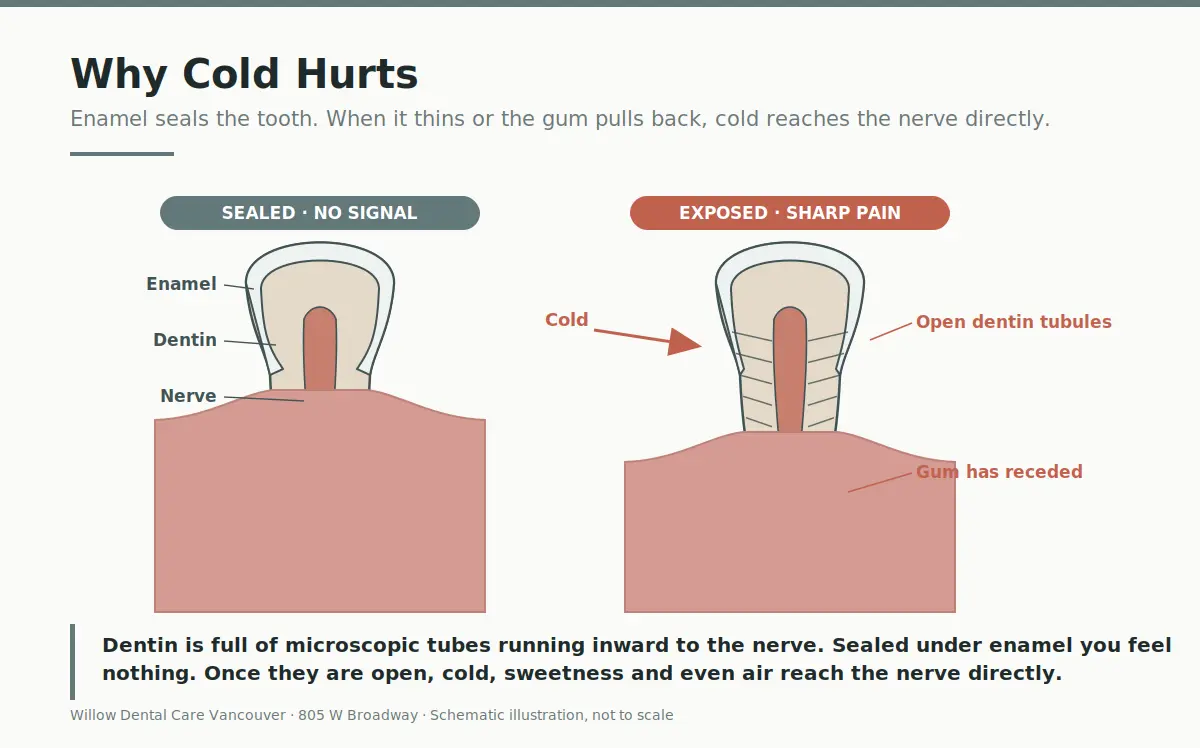
Your teeth have a hard outer layer of enamel. Underneath sits dentin, which is softer and, unlike enamel, is not inert. Dentin is full of microscopic tubes that run inward toward the nerve at the centre of the tooth.
While the enamel is intact, those tubes are sealed off and you feel nothing. When enamel wears thin, or the gum pulls back and exposes the root surface, the tubes are open. Cold, heat, sweetness and even air moving across the tooth now reach the nerve directly.
That is dentin hypersensitivity, and it is the most common reason a healthy tooth hurts with cold. Most people notice it for the first time somewhere in their thirties, and it tends to become more common with age.
The Usual Causes
Gum recession
The most common cause we see. Roots are not covered by enamel, so once the gum moves back the root surface is exposed and sensitive straight away. Recession comes from brushing too hard, from gum disease, from smoking, and simply from time.
Brushing too hard, with the wrong brush
This one surprises people because it feels like the opposite of a problem. A hard-bristled brush and a scrubbing motion wear enamel at the gum line and push the gum back at the same time. Soft bristles and small circular movements clean just as well.
Acid
Citrus, soda, sports drinks, wine and vinegar-based dressings all soften enamel temporarily. Reflux does the same thing from the inside, often without the person realising it, which is why sensitivity is sometimes the first sign of an issue that has nothing to do with the teeth.
One practical note: do not brush immediately after something acidic. The enamel is softened for a while afterwards and brushing at that moment removes more of it. Rinse with water and wait.
Grinding and clenching
Grinding wears enamel flat and can flex the tooth at the gum line until the surface chips away. If you also wake with a tight jaw, a headache at the temples or teeth that feel tender to bite on, grinding is worth investigating. That is a TMJ and TMD conversation as much as a sensitivity one, and a night guard often solves both.
Whitening
Sensitivity during and shortly after whitening is common and usually temporary. It matters more if your enamel is already thin, which is why it is worth having your enamel assessed before you start rather than after. Our teeth whitening page covers what that involves.
Recent dental work
A new filling or a cleaning can leave a tooth sensitive for a short while. That is normal. It should settle within days to a couple of weeks, not continue indefinitely.
Not sure whether yours is ordinary sensitivity or something else?
That is what an exam is for. We will find out which tooth it is, what is causing it, and whether it needs treating or just managing. Same-day appointments are available and you do need to call to arrange one. Direct billing to most insurance providers.
Call or request an appointment. We are on West Broadway, Monday to Friday.
The Two Signs That Mean It Is More Than Sensitivity
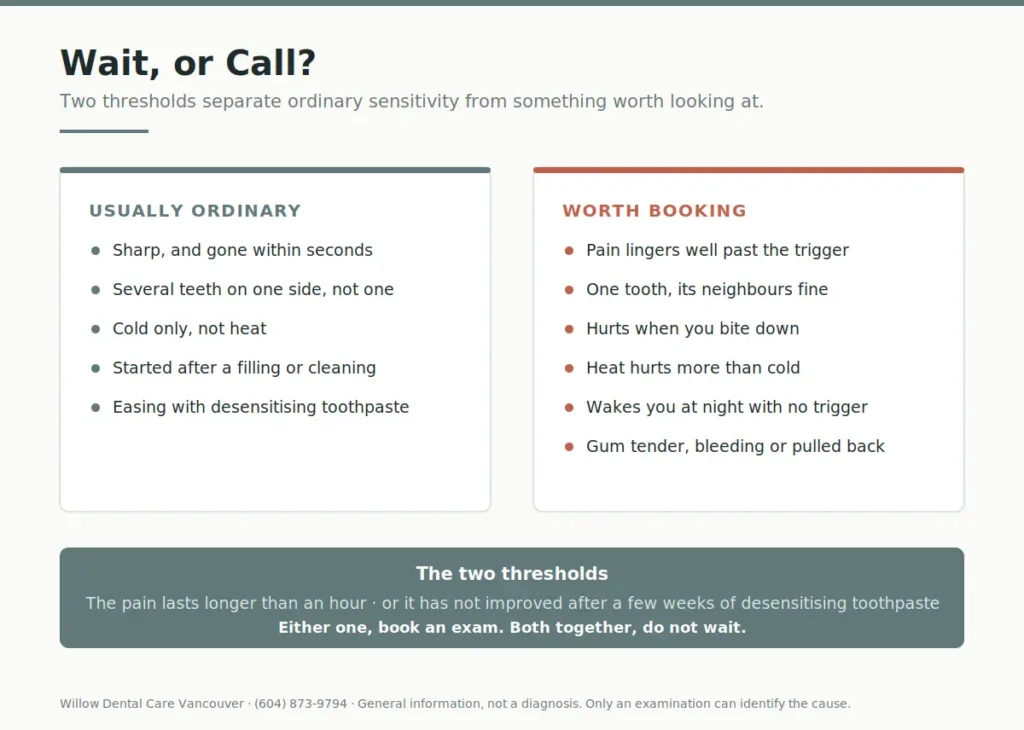
Dental sensitivity has two clear thresholds, and they are worth memorising because they are the difference between watchful waiting and booking an appointment.
The pain lasts longer than an hour. Ordinary dentin sensitivity is sharp and brief. It arrives with the cold and it leaves with it, usually within seconds. Pain that lingers well after the trigger has gone suggests the nerve inside the tooth is inflamed rather than simply exposed, and that is a different problem with a different treatment.
It has not improved after a few weeks of desensitising toothpaste. Those toothpastes work by gradually blocking the dentin tubes, and they need consistent use over several weeks. If you have given it a fair run and nothing has changed, something structural is going on that toothpaste cannot reach.
Either of those, book an appointment. Both of them together, do not wait.
Other patterns worth taking seriously
- One tooth, not several. General sensitivity across a whole side usually means worn enamel or recession. A single tooth that reacts sharply while its neighbours are fine points at that specific tooth: a crack, a cavity, or a failing filling.
- Pain when you bite down, not just with cold. A classic cracked tooth pattern, and often the pain comes on release rather than on pressure.
- Heat hurts more than cold. Generally a more concerning sign than cold sensitivity and worth prompt attention.
- It wakes you at night. Spontaneous pain with no trigger is not sensitivity. That is a reason to call.
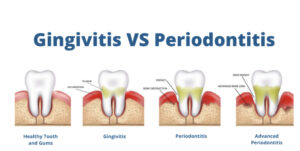
- The gum is tender, bleeding or has pulled back visibly. Sensitivity can be the first noticeable sign of gum disease, which is treatable and much easier to treat early. We covered the distinction in periodontal maintenance versus a regular cleaning.
What You Can Do at Home
None of this replaces finding out the cause, but it will help while you arrange an appointment and it is often all that is needed for mild cases.
- Switch to a soft-bristled brush and clean with small circles rather than back-and-forth scrubbing.
- Use a desensitising toothpaste and give it several weeks. Many people try it for four days, decide it does not work and stop. Rubbing a little onto the sensitive spot with a fingertip before bed and leaving it there helps.
- Cut back on acidic drinks, or use a straw, and rinse with water afterwards.
- Do not brush straight after anything acidic. Wait.
- Pause whitening products until you know what is causing the sensitivity.
- If your jaw is tight in the mornings, mention it. It changes what the treatment should be.
What a Dentist Can Actually Do
The first step is always finding out which tooth and why, which is what a dental examination is for. Treatment follows from the cause rather than the symptom.
| If the cause is | What usually helps |
|---|---|
| Exposed dentin or early recession | In-office fluoride varnish, which seals the tubes and lasts considerably longer than toothpaste alone. |
| A worn notch at the gum line | Bonding a thin layer of resin over the exposed area to cover it. |
| Decay | A white filling. Caught early this is straightforward. |
| A cracked or heavily worn tooth | Often a crown to hold the tooth together and stop the flexing that causes the pain. |
| An inflamed nerve | Root canal treatment. This is the one where waiting genuinely makes things harder. |
| Gum disease | Periodontal treatment, followed by a maintenance schedule. See our dental cleaning page. |
| Grinding | A custom night guard, which protects what is left of the enamel and usually eases the jaw as well. |
If the Reason You Have Not Gone Is the Appointment Itself
Worth saying, because sensitivity is one of the most common things people put off for years, and it is rarely because they do not know it needs looking at.
If dental visits are difficult for you, say so when you call. It changes how the appointment is planned. We offer sedation options for patients who find treatment hard, and it is a conversation we have often rather than an unusual request.
Frequently Asked Questions
Is tooth sensitivity normal?
A mild reaction to something very cold is common and not usually a concern. Pain in everyday situations, like drinking a cool glass of water, is not something to accept as normal. It means dentin is exposed somewhere and it is worth knowing why.
How long should I try desensitising toothpaste before giving up?
Several weeks of consistent use. It works by gradually sealing the tubes in the dentin and it is not an overnight fix. If there is no improvement after a few weeks, that is one of the two signals to have it looked at.
When does sensitivity mean a cavity?
A single tooth reacting sharply while the teeth around it are fine is more suggestive of a cavity, a crack or a failing filling than of general sensitivity. Pain on biting points the same way. An exam and an X-ray settle it quickly.
Can whitening cause permanent sensitivity?
It usually settles within a few days. If it does not, or if it was severe, have your enamel assessed before whitening again. Sensitivity during whitening can be a sign the enamel was already thin.
Why is one side of my mouth sensitive and not the other?
Often habit. People who brush harder on one side, chew mostly on one side, or grind asymmetrically wear that side faster. Sleeping position and reflux can also affect one side more than the other.
Does sensitivity go away on its own?
Sometimes. Sensitivity after a filling or a cleaning generally settles within days. Sensitivity from recession or enamel wear does not improve on its own, because the cause is still there and usually still progressing.
Can I still get a cleaning if my teeth are sensitive?
Yes, and it is often part of the solution rather than something to postpone. Tell the hygienist before they start so they can adjust their approach.
Is sensitive toothpaste enough on its own?
For mild sensitivity from exposed dentin, often yes. It does nothing for a crack, a cavity or gum disease, which is why persistent sensitivity should be looked at rather than managed indefinitely.
Book an Appointment
If cold has been bothering you for more than a few weeks, an exam will tell you what it is. Most of the causes are simple to treat when they are caught early, and the ones that are not get harder the longer they wait.
Willow Dental Care Vancouver is on West Broadway, serving Kitsilano, Fairview, Mount Pleasant, Yaletown and Downtown Vancouver. Direct billing to most insurance providers. Open Monday to Friday.
Call or request an appointment.