You may notice that your bite doesn’t look quite right when you close your mouth. Maybe your upper front teeth cover more of your lower teeth than expected, or your lower teeth sit in front of your upper teeth. The confusing part is that what looks like an overbite or underbite in the mirror doesn’t always tell you what’s actually causing it.
When people search for invisalign overbite underbite, they’re usually trying to answer a practical question: can clear aligners correct their bite, or will they need braces, additional orthodontic treatment, or even jaw surgery?
The answer depends less on the label and more on what’s happening underneath it. In particular, your dentist needs to determine whether the problem is mainly caused by tooth position or by the relationship between your upper and lower jaws.
What’s Actually Different Between an Overbite and an Underbite?
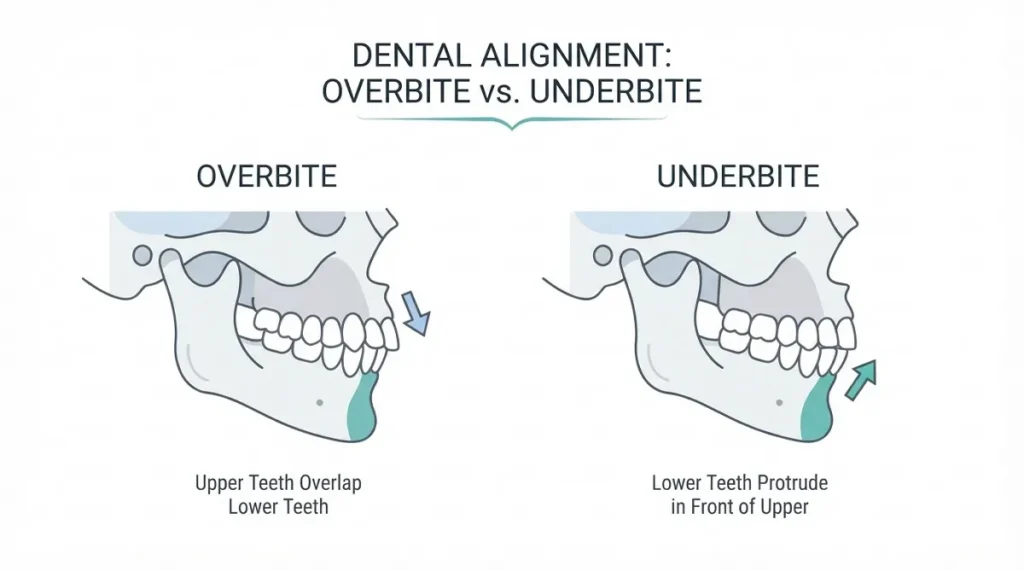
A healthy bite naturally includes a small amount of vertical overlap between the upper and lower front teeth, typically about 2 to 4 millimetres. An overbite describes that vertical relationship. The upper front teeth overlap the lower front teeth from top to bottom, and a deeper overbite, sometimes called a deep bite, occurs when the upper teeth cover substantially more of the lower teeth than that normal range. In more severe cases, the lower teeth can contact the gum tissue behind the upper teeth, which may lead to irritation and accelerated tooth wear.
An underbite is different. When you close your mouth, the lower front teeth sit in front of the upper front teeth. This can give the lower jaw a more prominent appearance and, in more significant cases, can affect how the back molars meet during chewing. Underbites can be caused by the position of the teeth, the position of the jaws, or a combination of both.
It’s also easy to confuse these problems with other bite conditions. A crossbite occurs when some upper teeth sit inside the lower teeth when you bite down, while an overjet refers to the horizontal distance between the upper and lower front teeth rather than their vertical overlap. In practice, patients frequently mistake general crowding, crossbites, or narrow arches for a classic overbite or underbite, which is exactly why a clinical assessment, not a mirror check, determines the right treatment.
Dental vs. Skeletal Bite Problems: Why This Distinction Decides Your Treatment
This is the most important part of an Invisalign candidate assessment.
A bite problem can be primarily dental, meaning the teeth are positioned incorrectly even though the underlying jaw relationship is reasonably proportionate. Orthodontic appliances work by applying controlled forces to teeth, allowing them to gradually move into different positions. This is the basic principle behind both braces and clear aligners.
A skeletal bite problem is different. The underlying issue involves the size, shape, or position of the upper and lower jaws. Moving teeth can compensate for some skeletal discrepancies, but aligners can’t reposition an adult jawbone the way they move individual teeth.
| Bite Issue Type | Primary Cause | Typical Clinical Approach | Invisalign Suitability |
| Dental Bite Misalignment | Teeth positioned or inclined incorrectly within an otherwise proportionate jaw | Clear aligners, conventional braces, attachments | Often a strong candidate for mild-to-moderate cases |
| Skeletal Bite Discrepancy | Upper and/or lower jaws differ significantly in size, shape, or position | Orthodontic treatment, sometimes combined with orthognathic surgery | May help with the dental component, but usually can’t correct the jaw relationship alone |

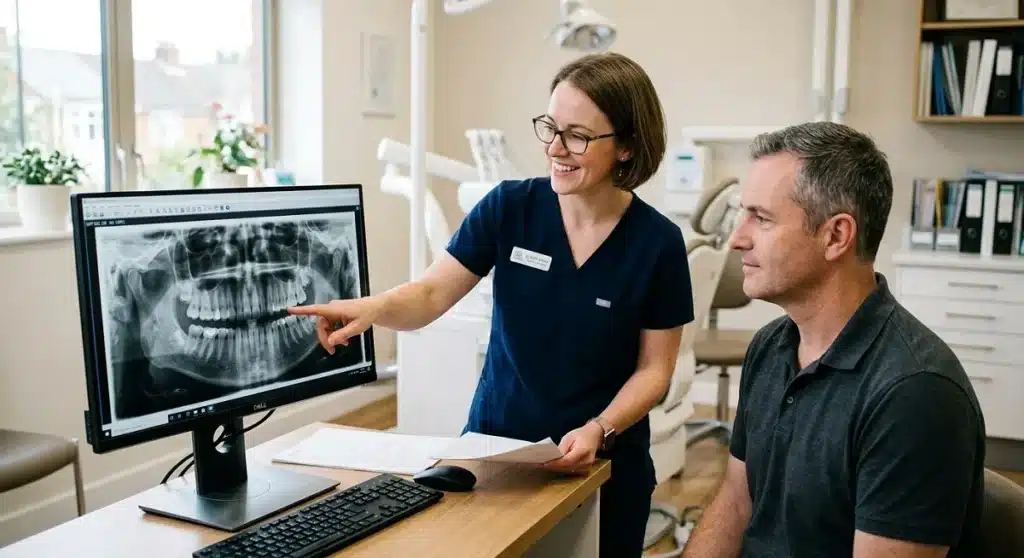
The Canadian Dental Association explains that orthodontic treatment changes tooth position and that the relationship between the teeth and jaws affects the bite. The American Association of Orthodontists similarly notes that orthognathic surgery is used when the upper and lower jaws are significantly out of position and the discrepancy affects function. That’s why a treatment plan shouldn’t be based only on a photograph or an online quiz. A dentist or orthodontist needs to evaluate your bite clinically, and appropriate imaging may be needed to understand whether the problem is primarily dental, skeletal, or a combination of both.
Can Invisalign Fix an Overbite?
In many cases, yes, particularly when the overbite is predominantly dental and falls in the mild-to-moderate range.
Clear aligners apply controlled, sequential forces to the teeth. Invisalign’s current system includes features specifically intended to improve control of deep-bite correction, including precision bite ramps (prominences built into the aligner that disengage contact between the back teeth so the front teeth can be guided into a better vertical position) along with SmartForce attachments, small tooth-coloured shapes that provide additional points of leverage. When needed, orthodontic elastics can add the inter-arch traction required to guide the upper and lower teeth into better harmony.
The evidence is strongest for relatively straightforward cases: a 2025 systematic review found that clear aligners and fixed appliances both performed well for simple malocclusions, while evidence for more complex cases remains less certain.
If an overbite is caused by a more significant skeletal discrepancy (for example, a notably underdeveloped lower jaw), aligners alone typically can’t fully correct the underlying jaw relationship. In that situation, Invisalign may still improve dental aesthetics and reduce the overlap, but a complete correction may require comprehensive orthodontic treatment or, in more severe cases, orthognathic surgery. This is why it’s more useful to ask “what’s causing my overbite?” rather than simply “is my overbite too big for Invisalign?”
Can Invisalign Fix an Underbite?
Sometimes, but underbites call for particularly careful assessment because a skeletal component is relatively common.
An underbite occurs when the lower front teeth sit ahead of the upper front teeth. In some people the problem is mainly dental, often limited to one or two front teeth caught behind the lower arch (sometimes called an anterior crossbite). In others, the lower jaw sits too far forward or the upper jaw sits too far back, creating a skeletal Class III relationship.
If the discrepancy is primarily dental, orthodontic treatment can often move the teeth, tipping the upper incisors forward and uprighting the lower incisors, into a healthier relationship, sometimes with the help of Class III inter-arch elastics. Invisalign’s official treatment information includes Class III (underbite) cases among the conditions its system is used to treat.
The important limitation. Not every underbite is an Invisalign-only case. When an adult has a significant skeletal discrepancy, moving the teeth alone may not achieve the desired correction, or may require an unhealthy amount of dental compensation. The American Association of Orthodontists notes that when an underbite involves a significant skeletal discrepancy, orthodontic treatment alone may not be enough, and orthognathic surgery may be recommended. That doesn’t mean every adult with an underbite needs surgery. It means the cause and severity of the jaw relationship need to be assessed before deciding whether aligners alone are appropriate.
Signs a Bite Problem Deserves a Closer Look
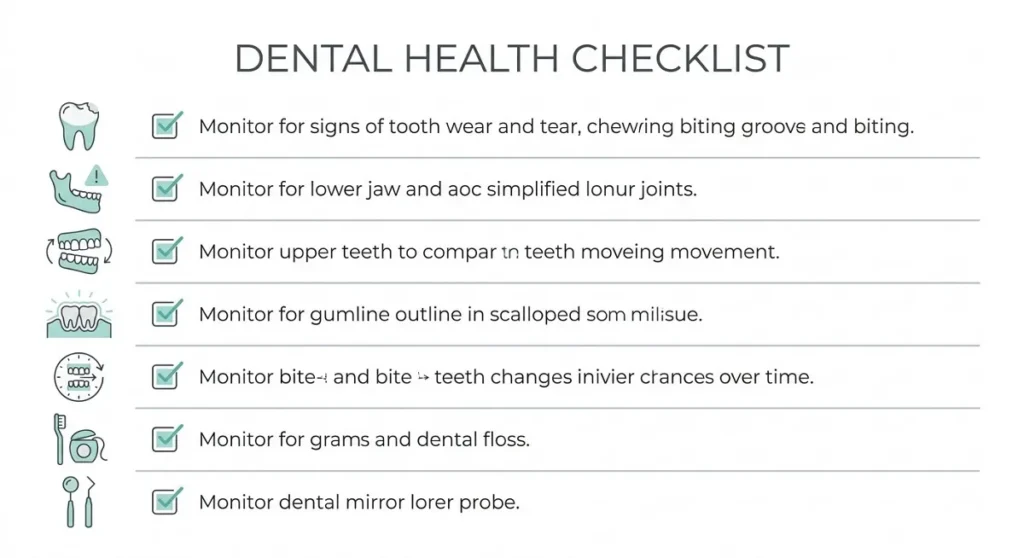
These signs don’t necessarily mean you have a serious bite disorder. They’re simply reasons not to rely on a mirror check alone:
- Difficulty biting or chewing comfortably
- Noticeable or progressive tooth wear or chipping
- Teeth repeatedly contacting the gums or other soft tissues
- Jaw discomfort, clicking, or tension associated with the bite
- Frequent, accidental biting of the cheeks or tongue
- A bite that appears to be changing over time
- Significant crowding or tooth displacement accompanying the bite problem
How Willow Dental Care Determines If You’re a Candidate
At Willow Dental Care Vancouver, determining whether Invisalign is appropriate for your bite starts with an assessment, not a promise about what aligners can do. The dentist evaluates how your upper and lower teeth come together, the position and condition of the teeth, and the overall relationship between the dental arches, including facial profile and jaw (TMJ) function where relevant. Depending on what’s found clinically, digital scanning and diagnostic imaging may be used to examine the roots, the supporting bone, and the relationship of the dental arches to the jaw.
This is consistent with the broader role of dentistry in British Columbia: under the current Oral Health Professionals Regulation, dentists are authorized to diagnose conditions they are authorized to prevent, treat, and manage. The British Columbia College of Oral Health Professionals is the provincial regulator for dentistry.
“Patients often visit our Broadway clinic convinced they have a serious structural underbite, when in reality they have a minor crossbite combined with anterior crowding that responds well to clear aligners. Before recommending Invisalign, we need to understand whether the problem is coming mainly from the position of the teeth, the relationship of the jaws, or both. That’s what tells us whether aligners are a sensible option for your particular case.” — Clinical Team, Willow Dental Care Vancouver
What to Expect If Invisalign Is Recommended for Your Bite
If the assessment indicates Invisalign is an appropriate option, treatment generally follows a structured process:
- Consultation and assessment: your dentist evaluates your bite, teeth, oral health, and treatment goals, taking records or imaging when needed.
- Treatment planning: your clinician builds a digital sequence of planned tooth movements for your specific bite, incorporating attachments, bite ramps, or elastics where appropriate.
- Aligner treatment: you wear a series of custom aligners, typically 20 to 22 hours a day, advancing to the next set on the schedule your dentist sets. The number of stages and overall duration vary considerably between patients.
- Progress monitoring: your dentist checks how your teeth and bite are responding and adjusts the plan if movements aren’t progressing as expected.
- Refinement, if needed: additional refinement aligners are sometimes used to fine-tune tooth position or the final bite.
- Retention: once active treatment is complete, retainers help maintain your new tooth positions, since teeth can shift after treatment ends.
The clinical literature supports clear aligners particularly well for mild-to-moderate malocclusions, though it also shows that some tooth movements are less predictable and that complex cases require careful clinical judgment. The goal isn’t just whether Invisalign can technically move your teeth. It’s whether it can move your teeth, in your particular bite, to the position you actually need.
Overbite or Underbite? Start With the Cause, Not the Appliance
You can casually observe whether your upper teeth overlap your lower teeth or whether your lower teeth sit in front. That’s a useful starting point for a conversation with your dentist. What you can’t reliably determine from a mirror is whether the underlying problem is dental or skeletal, and that distinction is what ultimately decides whether Invisalign alone is appropriate, whether another orthodontic approach would offer better control, or whether a combined orthodontic and surgical plan should be considered.
If you’re considering Invisalign in Vancouver, our team at Willow Dental Care can walk you through the assessment process and explain which options are realistic for your particular bite.
Frequently Asked Questions
Is it normal to have a slight overbite?
Yes. A small amount of vertical overlap, roughly 2 to 4 millimetres, between the upper and lower front teeth is part of a normal, healthy bite. Its presence by itself doesn’t automatically mean orthodontic treatment is necessary.
Can Invisalign fix an overbite?
Invisalign can correct many overbite and deep-bite cases by moving the teeth and controlling their vertical position. Whether it can correct your particular overbite depends on the cause of the problem, the movements required, and whether there’s a significant skeletal component.
Can adults still fix an underbite without surgery?
Some adults can have an underbite corrected without jaw surgery, particularly when the problem is primarily dental or the skeletal discrepancy is limited. A more significant skeletal underbite, however, may require combined orthodontic and surgical treatment. An in-person assessment is needed to tell these situations apart.
Is Invisalign better than braces for an overbite or underbite?
Neither is automatically better for every bite. Clear aligners can be effective for many orthodontic problems, but fixed appliances may offer advantages for certain complex tooth movements. The right appliance depends on the diagnosis and treatment goals, not a general preference for one over the other.
How long does treatment typically take?
Treatment length varies widely depending on whether the bite issue is mild or more complex and how consistently the aligners are worn. Simpler dental corrections tend to take less time than cases involving elastics and more significant tooth movement. Your dentist can give you a realistic estimate once your specific case has been assessed.
Will fixing my overbite change my facial shape?
Correcting a significant overbite can modestly improve lip support and jaw rest position. But because clear aligners move teeth rather than reconstruct the jawbone, the visible changes are generally centred on smile aesthetics and bite function rather than major structural change to the face.
How do I know if I’m an Invisalign candidate?
You can’t reliably determine this from the appearance of your teeth alone. A dentist or orthodontist needs to assess your bite, tooth positions, jaw relationship, oral health, and the movements required to achieve the result you want.