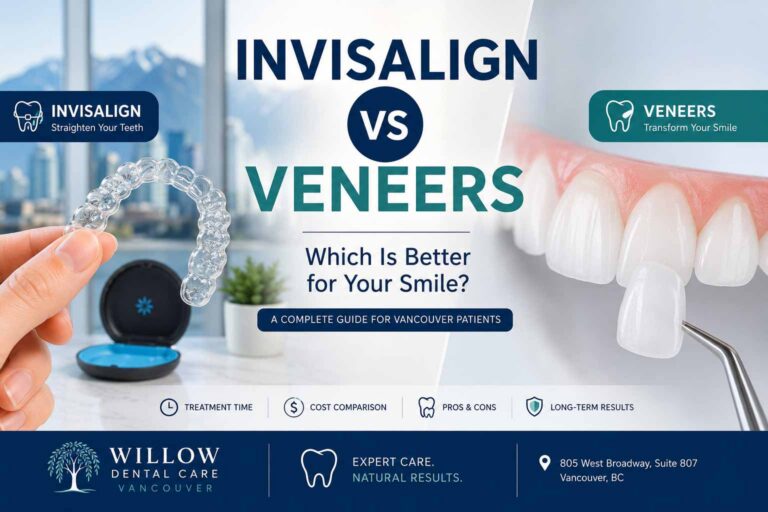
The universal desire for a quicker path to a perfect smile often leads individuals to explore various orthodontic treatments. Among the most popular options are traditional braces and the more modern Invisalign clear aligners. While Invisalign is often perceived as the faster solution, the reality is more nuanced. The speed at which either treatment delivers results depends on a combination of factors, making a definitive “faster” declaration impossible without considering individual circumstances.
Is Invisalign faster than braces?
For mild to moderate alignment problems, Invisalign is often as fast as or slightly faster than traditional braces because treatment is carefully planned with digital technology and aligners are changed every 1–2 weeks.
However, for more complex cases, braces may be the faster and more effective option because they provide the orthodontist with greater control over tooth movement.
Typical Timelines: Braces and Invisalign Compared
To understand which might be faster, it’s essential to look at the typical treatment durations for both. Traditional braces, consisting of metal or ceramic brackets and wires, work by applying continuous pressure to gradually shift teeth into their desired positions. On average, patients can expect to wear braces for 18 to 24 months, though complex cases can extend well beyond two years.
In contrast, Invisalign utilizes a series of custom-made, clear plastic aligners that are changed every one to two weeks. Each new set of aligners is designed to make slight adjustments to tooth position. For many, Invisalign treatment can range from 6 to 18 months. However, it’s crucial to note that complex orthodontic issues treated with Invisalign can also take 24 months or even longer, aligning with the timelines of traditional braces. Initially, Invisalign often appears to have the edge in speed for certain types of cases, but this is not a universal truth.
Factors Influencing Treatment Speed for Both
The perceived speed of orthodontic treatment is significantly influenced by several key factors, regardless of whether you choose braces or Invisalign.
Firstly, the complexity of the case plays a paramount role. Mild crowding or spacing issues are generally quicker to correct than severe bite discrepancies, significant rotations, or large gaps. Invisalign is often highly effective and potentially faster for mild to moderate cases. Traditional braces, with their fixed nature and ability to exert more precise and powerful forces, are typically better suited for severe and complex orthodontic problems that require significant tooth movement or bite correction.
Patient compliance is another critical factor, particularly for Invisalign. For Invisalign to be effective and stay on track with projected timelines, aligners must be worn for 20 to 22 hours per day. Failing to wear them consistently can lead to delays, require additional aligners, or even reverse progress, ultimately extending treatment. While braces don’t require daily removal, patient compliance is still vital for oral hygiene, avoiding certain foods that can damage the appliance, and wearing prescribed elastics, which are crucial for correcting bite issues.
Patient age also influences treatment speed. Adolescents, whose bones are still developing and are more malleable, often experience faster tooth movement compared to adults, whose jawbones are fully formed and more rigid.
Furthermore, the orthodontist’s expertise and the meticulously crafted treatment plan are crucial. A precise diagnosis and a tailored plan, along with consistent, regular check-ups and adjustments, ensure that treatment progresses efficiently. Finally, biological response varies from person to person; some individuals’ teeth simply move faster than others.
When Invisalign May Be Faster
Invisalign often shines in terms of speed for individuals with relatively simple cases, such as minor crowding, small gaps, or slight misalignments. In these scenarios, the staged movements offered by the clear aligners can be highly efficient. Moreover, patients with excellent compliance those who diligently wear their aligners for the prescribed hours each day will undoubtedly experience quicker progress with Invisalign. Certain types of tooth movements, particularly those that involve tipping or rotation, can sometimes be achieved more efficiently with Invisalign’s aligner staging.
When Braces May Be Preferred or More Efficient
Conversely, traditional braces often prove to be the more efficient choice for severe and complex cases. This includes significant rotations, very large gaps, and severe bite discrepancies like deep overbites or crossbites. Braces are also generally preferred when extractions or other adjunctive procedures (like surgical interventions) are required, as they offer more control over complex tooth movements. For patients who may have compliance concerns perhaps due to forgetfulness or a busy lifestyle fixed braces eliminate the need for daily self-management, ensuring continuous treatment without the risk of non-compliance-related delays.
Conclusion
Ultimately, the question of whether Invisalign is “faster” than braces doesn’t have a simple, universal answer. While Invisalign can offer a quicker path to a perfectly aligned smile for simple to moderate cases and highly compliant patients, traditional braces often remain the more efficient and effective solution for complex orthodontic challenges. The most crucial step in determining the best and most efficient treatment option for your individual needs is to schedule a professional orthodontic consultation. An experienced orthodontist can accurately assess your specific case, discuss your lifestyle, and recommend the treatment that will lead to a healthy, aligned smile in the most effective timeline for you.
Ready to discover your fastest path to a confident smile? As specialists in Invisalign in Vancouver, Willow Dental Care Vancouver is here to help. Contact us today for a personalized consultation and let’s discuss if Invisalign is right for you